Self-Levelling Epoxy Resin Flooring Contractors
Seamless, smooth-finish epoxy resin flooring for factories, warehouses, commercial premises and production areas. Full mechanical preparation and specification-led installation for demanding working environments.
What is self-levelling epoxy resin flooring?
Self-levelling (SL) epoxy is a flow-applied resin flooring system designed to produce a continuous, smooth and hard-wearing surface. It is used where an industrial or commercial floor needs an even, cleanable finish, subject to the traffic, chemical exposure, cleaning regime and slip-resistance specification.
Unlike a thin paint coating, an SL system is generally applied as a higher-build resin layer. It is not a substitute for correcting major structural defects or poorly prepared concrete. Final build-up, thickness, texture and curing must be selected from the manufacturer's specification.
Where SL epoxy floors are used
- Factories and manufacturing areas
- Warehouses, industrial units and distribution facilities
- Automotive workshops and selected service areas
- Commercial production and storage spaces
- Other areas requiring a smooth, seamless resin finish
Where frequent wet cleaning or slip hazards are present, a textured or aggregate-broadcast alternative may be more appropriate than a smooth SL finish.
Preparation determines the result
We assess the concrete before specifying the resin. Mechanical grinding or shot blasting may be required to remove laitance, contaminants or old coatings and produce the profile needed for the chosen system.
Any cracks, local defects, joints and moisture concerns need a suitable repair or treatment strategy. Epoxy damp-proof membranes may be considered where appropriate to the tested substrate and manufacturer requirements.
Our surface preparation services →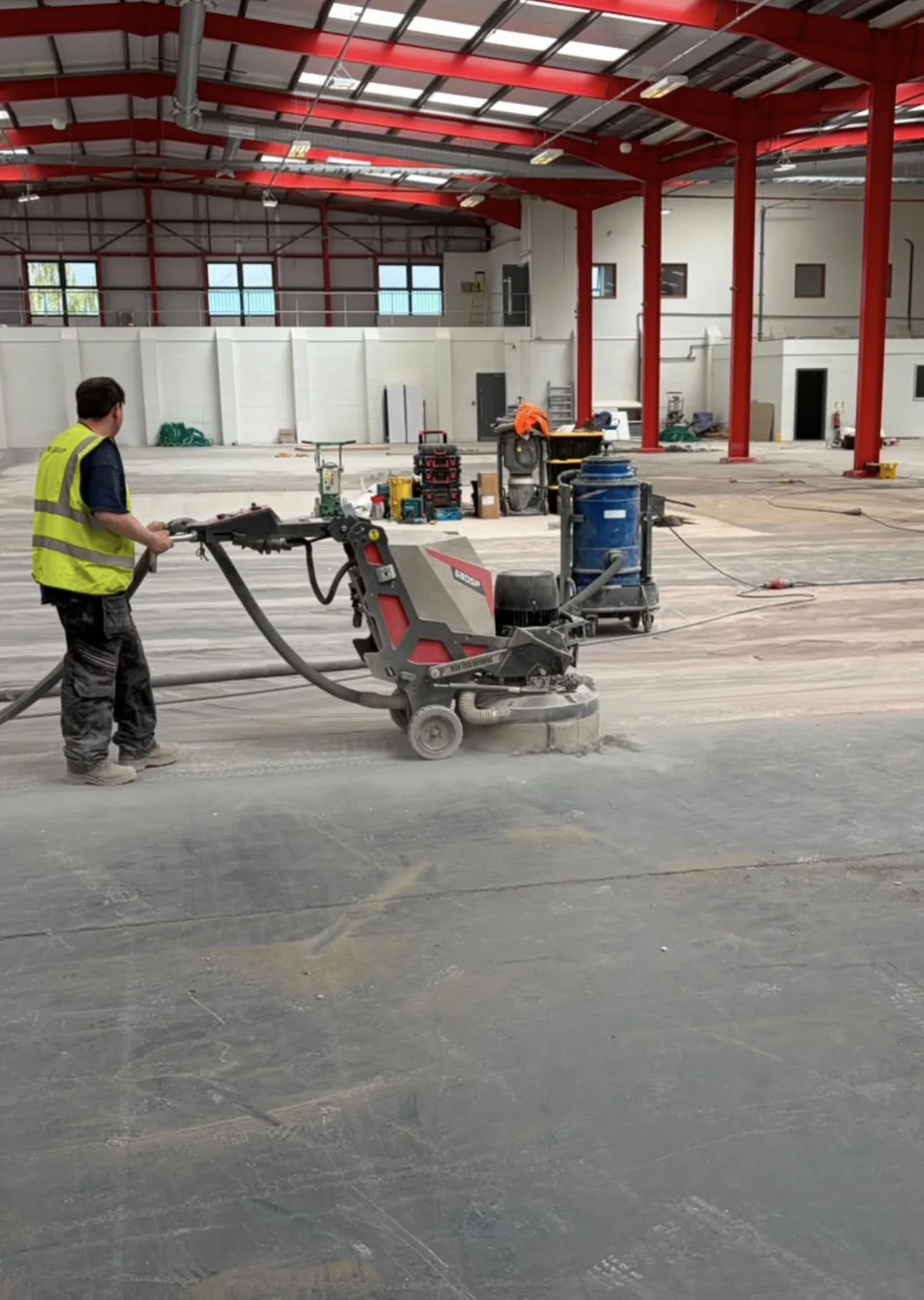
How a self-levelling epoxy floor is installed
1. Site survey and floor assessment
We review the floor area, current substrate, previous coatings, traffic, cleaning requirements, desired finish, operational access and available shutdown window. Moisture and contamination checks are considered where relevant.
2. Mechanical preparation
Diamond grinding or shot blasting is selected to achieve the required concrete surface profile. Edges, details and hard-to-reach areas are prepared as needed, followed by thorough dust removal.
3. Repairs and local levelling
Cracks, joints, holes and surface defects are assessed. Repairs are specified to suit the substrate and proposed resin system. Movement joints may need to be carried through the finish.
4. Primer and moisture control
A compatible primer is applied in accordance with the manufacturer's instructions. If moisture is a concern, the appropriate test and moisture-control specification must be agreed before coating.
5. Mixing and applying the SL epoxy
The selected resin components are mixed and applied at the specified coverage and thickness. Application tools and methods depend on the system, with attention to working time, temperature and an even finish.
6. Cure, inspection and handover
Pedestrian access, vehicle traffic and full chemical resistance can have different return-to-service times. These are confirmed against the specific product data sheet and actual site conditions.
Industrial resin flooring application
These photographs were supplied for CCNW's warehouse flooring pages and show resin coating work in progress. The precise resin product and build-up are not independently verified, so they are not labelled as a completed self-levelling epoxy project.
See more CCNW projects →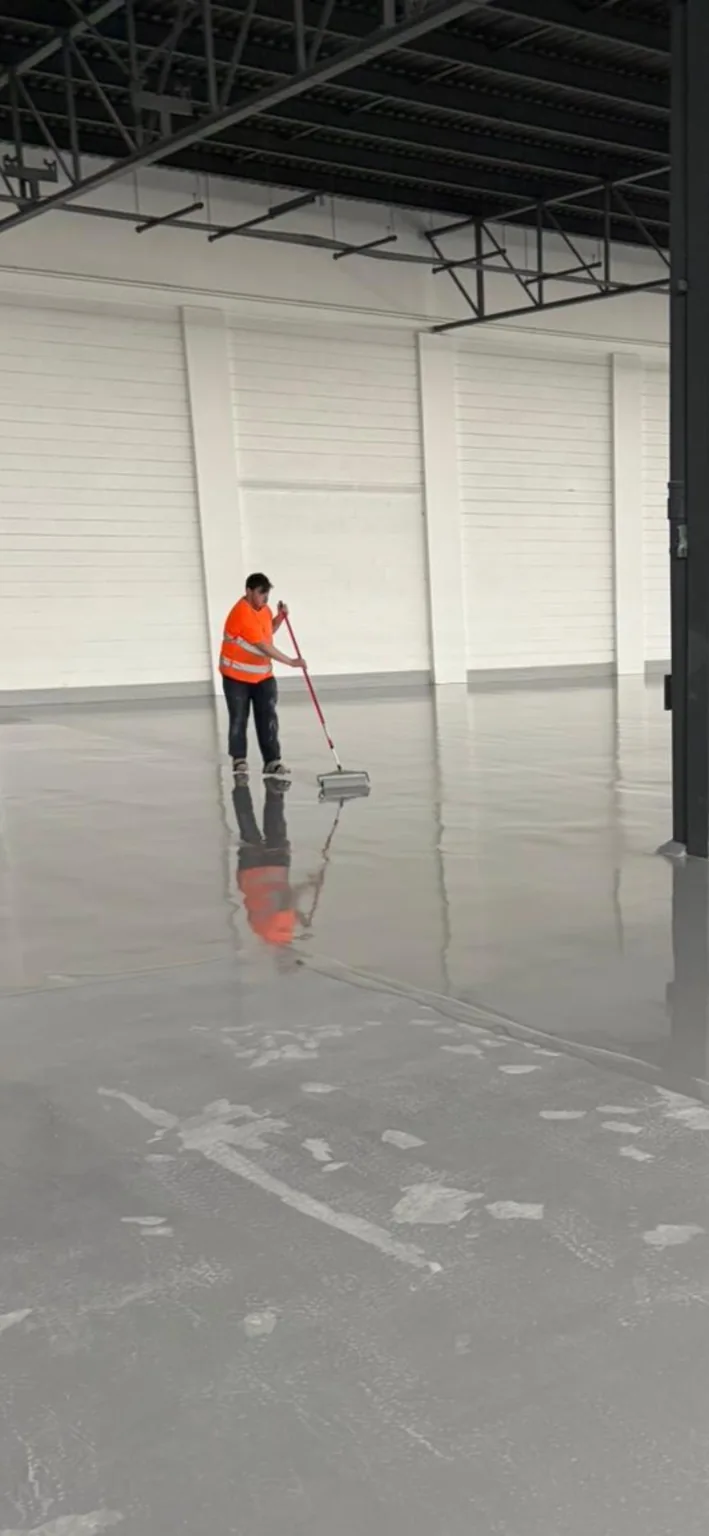
SL epoxy resin flooring: common questions
Is self-levelling epoxy suitable for forklift traffic?
It may be, depending on loading, wheel type, substrate strength, impact exposure and the selected system. A site-specific specification is required.
Will SL epoxy cover uneven concrete?
It can accommodate minor surface variation within system limits, but significant unevenness, cracks and defects usually require preparation or repair first.
Is a smooth SL floor slip resistant?
A smooth finish can become slippery when wet or contaminated. Slip resistance should be assessed against actual use, with a textured system considered where needed.
How long before the floor can be used?
Return-to-service depends on product, temperature, layer thickness and intended traffic. No universal cure time should be assumed.
Do you cover projects outside the North West?
Yes. CCNW welcomes larger industrial and commercial project enquiries throughout the UK, alongside work in Liverpool, Wirral, Cheshire, Manchester and North Wales.
Send the location, floor area in m², current floor condition, photographs, desired finish and project dates.
Related: Epoxy resin flooring · PU screed flooring · MMA flooring · Warehouse flooring.
How much does self-levelling epoxy at 2–3 mm cost?
£40–£90 per m²Guide range for a 2–3 mm self-levelling epoxy system.
Preparation and specification may change the price. Final costs depend on site condition, floor area, required system and thickness, access and programme. Grinding, coating removal, repairs, contamination treatment, DPM and levelling may add to the cost. Small areas may attract a minimum job charge.
These are indicative UK market ranges from published third-party guides, not a CCNW quotation or fixed price. VAT treatment is not consistently stated in the source guides; your CCNW quotation will confirm the applicable VAT and all inclusions.
Get an online quote →Published market guide: view pricing source. Checked 1 November 2026.
Planning your project: four useful questions
What affects the cost of self-levelling epoxy?
Floor area, existing condition, specification, access and programme affect pricing. See the budget guide on this page for the indicative range and exclusions. The written quotation confirms scope and applicable VAT.
What preparation does the floor need?
The concrete must be prepared and major defects or unevenness addressed before applying the specified resin. Moisture and compatibility also need assessment.
How long before the area can be used again?
The selected product, temperature, thickness and intended use determine curing and return-to-service. Foot traffic, vehicle traffic and installation of the next covering may require different allowances; these are agreed for the project.
Is this service suitable for my premises?
Self-levelling epoxy can suit industrial interiors requiring a smooth higher-build resin finish. Wet or contaminated areas may need a textured alternative.